Innokentii Dudorov
Doctor ZhivagoInnokentii Dudorov—known as Nika in childhood and later simply as Dudorov—is both a companion to Yurii Zhivago across decades and a measure of how political power enters private lives. The son of a condemned revolutionary and a Georgian princess, he grows from an unruly, imaginative schoolboy into a historian, suffers repeated deportation and imprisonment, and ultimately serves in a penal battalion. His changing public circumstances do not erase the intimacy of his old friendships, but they sharpen the difference between lived conviction and the language of conformity.
Identity and Family Background
Dudorov is the son of Dementii Dudorov, a revolutionary terrorist condemned to death by hanging and reprieved by the Tsar, and a Georgian princess of the Eristov family. At the time of Nika’s childhood, his father is doing forced labor. His mother is described as beautiful, still young, and repeatedly infatuated with causes and people: rebellions, rebels, extremist theories, famous actors, and unhappy failures. She adores her son, turning his name, Innokentii, into affectionate diminutives such as Inochek and Nochenka, and takes him to Tiflis to show him to her family.
The family’s political history makes the boy’s name a matter of risk as well as inheritance. Because it is dangerous for him to bear his father’s notorious name, Ivan Ivanovich wishes him to take his mother’s surname and plans to petition the Tsar, with her consent, for permission to change it. That proposed change is still unresolved when Nika is a schoolboy. Under a bed, hiding from visitors and indignant at the adults’ intrusion, he thinks about the plan as another attempt to meddle in his life.
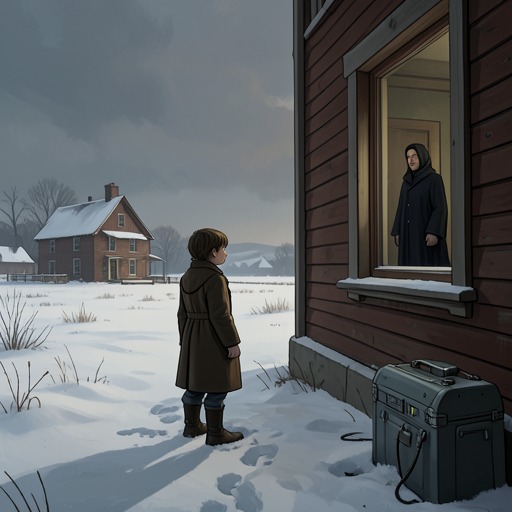
Nika’s early manner is intense and self-dramatizing. When excited, he talks aloud to himself, echoing his mother’s taste for lofty subjects and paradox. Looking at a trembling aspen, he wonders about life, pain, and God, then wills the tree to stop; in his imagination, it freezes at his command. The episode presents his childhood not as quiet precocity but as an effort to test his own power against the animate world. In Tiflis, a huge courtyard tree with elephant-ear leaves similarly resists ordinary categories: he cannot get used to the idea that it is a plant rather than an animal.
School Friendship and Revolutionary Childhood
Nika is two years older than Yurii and seems to him likely to look down on him. Their greeting at Duplyanka is memorable for its physical awkwardness: Nika grips Yurii’s hand, jerks his arm downward with all his might, and bows so low that his hair hides half his face. The gesture makes him at once formidable and boyish, and it establishes an early friendship that later survives radically different political fortunes.
At Voskoboinikov’s home, Nika hides under a bed when guests arrive, calling the unwelcome presence of one visitor “old Holy Oil” in his thoughts. The room has two beds, his and Voskoboinikov’s; when the visitors enter, Nika remains concealed while they search other rooms. After the guests leave for the veranda, he quietly opens a window, jumps out, and escapes into the park. His hiding is comic in its childish indignation, but it also echoes the precariousness of his family circumstances: the boy whose father has been condemned and reprieved resents the adults’ authority and imagines his life as something they may seize or rename.
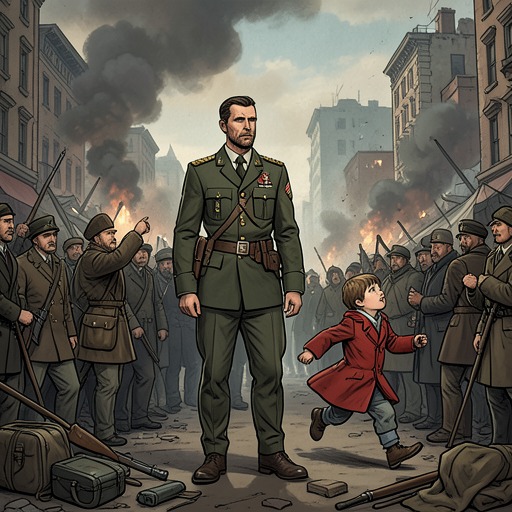
During the Presnia uprising, Nika is among the boys who go to the workers’ militia assembly point in the neighboring yard of the Guishars’ flat. Lara knows him through her school friend Nadia and sees him as proud, straightforward, and taciturn. He and Pavel Antipov play at war in a city where participation in the actual conflict can bring deportation or hanging. Their woollen caps, tied at the back, remind Lara that they are still children cared for by parents. The boys’ play and the city’s real violence are not separated cleanly: revolver shots sound from the house where they hide, yet Lara thinks of the fighters as good, decent boys whose goodness is part of what leads them to shoot. Nika’s childhood is thus framed by a double image, innocence carried into danger and the political violence that makes even children’s games perilous.
Scholar and Adult Friend
In adulthood, Dudorov’s character appears to reverse. As a schoolboy he was flippant and featherbrained; he was expelled for helping political prisoners escape, tried several art schools, and eventually became a humanities student. During the war he graduated from university later than his schoolmates. By the time he reunites with Yurii, he is a serious scholar holding chairs in both Russian history and general history, and the author of two books: one on Ivan the Terrible’s land policies and another on Saint-Just. At a gathering, he speaks amiably about people and subjects in a muffled, lecture-like voice, gazing dreamily at a fixed point in the distance.
The novel first introduces his later life through a story Gordon tells while the friends wait for him. Dudorov had been drafted into the army by mistake and was repeatedly punished for forgetting to salute officers. After his discharge, the habit lingered: he would raise his arm when an officer appeared and sometimes imagine epaulettes where there were none. The circulating account then describes him meeting two sisters at a Volga port while waiting for a steamer and, confused by the presence of army men and his military memories, falling in love with the younger sister and proposing on the spot. Gordon presents the story as comic, but Dudorov’s arrival interrupts the anecdote before it can settle into a simple joke. The episode associates the disruptions of military service with behavior that follows a person back into civilian life.
Dudorov remains one of Yurii’s childhood friends, and their reunion restores an old intimacy even as adult habits have altered them. At the gathering, he addresses Yurii with the formal “you,” rather than their customary familiar form, and repeatedly asks whether he has read Mayakovsky’s War and the World and Flute-Spine. When the noise prevents Yurii from answering, Dudorov asks again about Flute-Spine and Man. Their exchange brings literature into the room not as an abstract subject but as one of the ties through which old friends test their continuing understanding of one another.
Years later, Dudorov sits with Yurii, Gordon, Marina, and the children in Gordon’s unusual living room. The room has been fitted between the lower and upper floors of a former tailor’s shop; its window begins at floor level, is only about three feet high, and retains part of the shop’s gold lettering. From the street, a passerby can see anyone inside up to the knees, while the children are wholly visible through the glass. After Marina takes the little girls away, the three former schoolmates remain for an unhurried summer conversation. The setting makes their friendship visibly exposed to the street even as the adults settle into the privacy of memories and argument.
Deportation, Conformity, and War
Dudorov returns from his first deportation with his civil rights restored and permission to resume his university work. He describes his experiences frankly and without apparent hypocrisy or fear. The prosecution’s arguments, prison treatment, life after prison, and especially private conversations with the examining judge, he says, have “aired” his brains, politically re-educated him, opened his eyes, and made him more mature. The account is not presented as a confession extracted under visible duress: Dudorov believes what he is saying.
That sincerity is precisely what makes the conversation troubling to Yurii. Gordon agrees with Dudorov, moved by the familiar, approved expressions as if they were spontaneous humanity. Yurii, by contrast, recognizes their conventionality and resents the sanctimonious political mysticism they represent. He privately thinks that people who are not free idealize their bondage. Yet he keeps his judgment to himself, unwilling to wound his friends. Dudorov’s speech therefore exposes more than the effects of punishment on one man: it shows how repression can be internalized as a story of enlightenment, and how friendship can restrain a listener from saying what he sees.
Dudorov’s later account of imprisonment gives that history material form. He describes arrival at a penal camp in a snowy wilderness, with forest in the distance, armed guards, and wolfhounds. New arrivals are arranged in a large polygon facing outward, ordered onto their knees, and kept from looking at one another during hours of roll call. His group is then shown an open snowfield, a post, and a notice marked “GULAG 92 Y.N. 90”: that is the camp they must make their own. Prisoners break saplings with bare hands in bitter cold to build huts, then construct the prison, stockade, cells, and watchtowers themselves before being put to work cutting and hauling timber.
He says his own second sentence followed automatically from the first, though it fell under a different article and brought different conditions. After that term he was again reinstated and allowed to lecture. When mobilized, he received his full rank of major rather than being assigned to a disciplinary battalion, as another former prisoner was. His account places the varying treatment of prisoners alongside the larger machinery of punishment: release and reinstatement do not cancel the repeated sentence, nor the labor through which inmates build the institutions that confine them.
Wartime Loss and Narrative Significance
Dudorov’s fiancée, Christina Orletsova, is remembered in a conversation during the Second World War. They became engaged and decided in the summer of 1941 that they would marry after the war. Army transfers carried Dudorov from place to place until he lost touch with her. He learned of her exploit and death from newspapers and regimental orders, as other people did. Christina had entered German lines and blown up the fortified Stables building, which was holding up the advance; she was captured alive and hanged. Dudorov says a monument may be erected near the site, while Yurii’s brother, General Evgraf Andreievich Zhivago, is collecting information about her.
The telling distinguishes intimate loss from public commemoration. Dudorov and Christina had planned a future together, but wartime displacement severed their contact before her death. He knows her final act through the impersonal channels of news reports and orders, and her story is already becoming the subject of a possible monument and a general’s inquiry. Asked about her, he does not turn the account into a heroic performance; he shifts the conversation back to the practical business of washing and bathing, then says he will lie on the bank, chew a blade of grass, and think, perhaps sleeping.
Dudorov also explains that he volunteered for frontline service in a disciplinary battalion under a policy promising freedom to those who survived. His penal-camp group had been kept in ignorance of the war for a long time before the offer came. They faced successive attacks, electrified barbed wire, mines, mortars, and months of artillery fire; their company was called the death squad and was nearly wiped out. Dudorov cannot explain how or why he survived. Yet he says that even this ordeal seemed like bliss beside the concentration camp—not because its material conditions were better, but for a different reason. His comparison refuses a simple scale of suffering and turns survival into a question of what kind of experience a person is being made to endure.
Across his life, Dudorov occupies several positions shaped by institutions: the son of a condemned revolutionary, a schoolboy punished for assisting political prisoners, a scholar permitted to return after deportation, a repeated prisoner, and a soldier whose service may secure release. The novel does not make these positions into a single, seamless political identity. Instead, Dudorov’s childhood rebelliousness, adult academic seriousness, sincere adoption of official explanations, and stark testimony about the camps remain in tension. Through his long friendship with Yurii and Gordon, that tension becomes personal: political language can be believed, repeated, questioned, or silently endured, while the costs of history are carried in interrupted careers, lost attachments, and lives that continue after the people they loved are gone.